

#USChinaTradeWar #EconomicTensions #EuropeEconomy #GlobalTrade #CurrencyWars #EurozoneChallenges #InternationalRelations #EconomicPolicy
As the United States and China fortify their positions in what appears to be an increasingly entrenched economic conflict, the ramifications for global trade and economic stability are profound. This confrontation, often framed as a trade war, has broader implications beyond just tariffs and trade barriers. It’s a contest for technological superiority, influence in developing economies, and control over global economic institutions. The US, wielding its powerful dollar and significant control over international financial systems, and China, with its manufacturing prowess and strategic investments in infrastructure and technology globally, are essentially redrawing the lines of global economic power. But amidst this high-stakes standoff, Europe finds itself in a precarious position, navigating a narrow path between two economic superpowers.
Europe’s challenge is multifaceted. On one hand, it lacks the luxury of self-sufficiency that the US enjoys, thanks to the latter’s technological edge and role as a global financial hub. On the other hand, it cannot merely pivot to China, as the dependency on Chinese manufacturing comes with its own set of risks, including over-reliance on a single supplier and potential political leverage being wielded by Beijing. The Eurozone, with its shared currency but diverse political landscapes, faces the arduous task of forging a coherent strategy that ensures its economic stability and independence. The situation is further complicated by internal disparities among EU member states in terms of economic strength and political will to confront or collaborate with these superpowers.
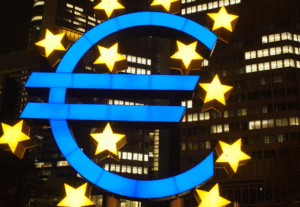
Europe’s response to this scenario involves a delicate balancing act. It must diversify its economic partners and reduce dependency on China for manufacturing, while simultaneously engaging with China to ensure access to its markets. The US, on the other hand, remains a vital ally, both economically and in terms of security. Yet, the relationship is not without its tensions, particularly concerning trade policies and the US’s aggressive stance towards China. Europe’s strategy could involve strengthening the Euro, seeking to position it as a more significant global currency, and thereby reducing the dominance of the dollar. This could offer Europe more economic autonomy and leverage. However, this move requires significant coordination and agreement among EU members, alongside deep structural reforms.
Moreover, Europe needs to invest heavily in technology and innovation, positioning itself as a global leader in key industries of the future such as renewable energy, digital services, and artificial intelligence. This does not only serve economic interests but also becomes a geopolitical strategy, enabling Europe to hold its own in the global arena, neither overly reliant on the US nor unduly influenced by China. Nonetheless, this necessitates a substantial commitment to research and development, education, and infrastructure, coupled with a regulatory environment that nurtures innovation and competition.
In conclusion, as the US and China continue to shape the future landscape of international trade and economic dominance, Europe must navigate this complex environment with strategic agility. By diversifying its economic dependencies, investing in strategic sectors, and strengthening its political and economic unions, Europe could carve out a path that ensures its sovereignty and economic resilience in the face of global shifts. This will not be an easy or quick process, but it’s crucial for Europe’s future in an increasingly multipolar world economy.


Comments are closed.